Ratio Calculator - Simplify Ratios & Solve Proportions
Simplify ratios to their smallest whole numbers, solve for missing values in proportions, and divide amounts into exact proportional shares.
🔒 Secure Calculation: Fast and private with zero data stored.
How to Use
- Pick a ratio operation from the Calculation Type dropdown above.
- Type your known numbers into the boxes, leaving one box blank when solving a four-term proportion, or click Sample to test.
- Read the simplified ratio, solved variable, or part-by-part share breakdown with full calculation steps below.
Options Explained
- Calculation Type: Switches between solving for a missing value in a four-term proportion (A : B = C : D), simplifying a two-term ratio (A : B), and dividing a total amount across two or three ratio parts (A : B or A : B : C).
Key Features
- Solves any missing term in a four-part proportion (A : B = C : D) or checks equality when all four terms are entered.
- Reduces whole-number and decimal ratios to their lowest integer terms using the greatest common divisor (GCD).
- Converts any two-term ratio into both unit ratio forms (1 : n and n : 1), fractions, and part-to-whole percentages.
- Splits any total quantity across two-part (A : B) or three-part (A : B : C) ratios with exact share values and percentages.
- Validates positive ratio inputs automatically to prevent division-by-zero errors and invalid negative proportions.
- Runs all ratio calculations 100% locally in your browser with zero server data storage.
Ratio and Proportion Formula and Step-by-Step Proof
The ratio calculator solves missing variables, reduces ratios to lowest integer terms, and distributes totals using cross-multiplication and greatest common divisor (GCD) arithmetic:
1. Proportion Cross-Multiplication: A × D = B × C ⇒ D = (B × C) / A
2. Ratio Simplification: Simplified Ratio = (A / GCD(A, B)) : (B / GCD(A, B))
3. Unit Ratios (1 : n and n : 1): 1 : (B / A) and (A / B) : 1
4. Proportional Share Division: Share_A = Total × (A / (A + B + C))
Scaling decimal inputs to whole numbers before dividing by their greatest common divisor and keeping full precision during intermediate steps prevents rounding drift across multi-part share calculations.
Developed and maintained by the CalcPly team, this calculator follows standard proportion rules and greatest common divisor (GCD) arithmetic for accurate numerical results.
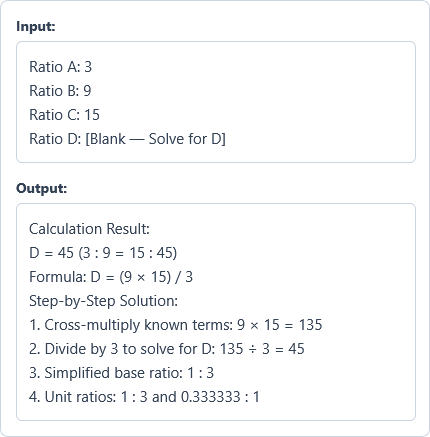
Example Input and Output
Example Input
Ratio A: 3
Ratio B: 9
Ratio C: 15
Ratio D: [Blank — Solve for D]
Options used: Calculation Type: Solve Proportion (A : B = C : D)
Example Output
Calculation Result:
D = 45 (3 : 9 = 15 : 45)
Formula: D = (9 × 15) / 3
Step-by-Step Solution:
1. Cross-multiply known terms: 9 × 15 = 135
2. Divide by 3 to solve for D: 135 ÷ 3 = 45
3. Simplified base ratio: 1 : 3
4. Unit ratios: 1 : 3 and 0.333333 : 1
Cross-multiplying 9 by 15 and dividing by 3 yields an exact fourth term of 45, maintaining a consistent 1 : 3 proportion on both sides.
Frequently Asked Questions
What is the difference between a ratio and a proportion?
A ratio compares the relative size of two or more quantities, whereas a proportion is an equation stating that two ratios are equal. For example, 3 : 9 is a single ratio, while 3 : 9 = 15 : 45 is a proportion because both sides reduce to the same 1 : 3 relationship.
How do you solve for a missing value in a proportion?
Cross-multiply the two known diagonal terms and divide that product by the remaining third term. In the proportion A : B = C : D, the outer product equals the inner product (A × D = B × C), so you can find an unknown D by calculating (B × C) ÷ A.
How does the calculator simplify ratios that contain decimals?
It multiplies both numbers by a power of 10 until they become whole numbers, then divides both by their greatest common divisor (GCD). For instance, the ratio 1.5 : 2.5 is first multiplied by 10 to become 15 : 25, and then divided by a GCD of 5 to reach 3 : 5.
What is a unit ratio (1:n or n:1)?
A unit ratio expresses the relationship between two quantities by setting either the first term or the second term equal to 1. Dividing both sides of A : B by A produces the 1 : (B / A) form, while dividing both sides by B gives the (A / B) : 1 form, making direct per-unit comparisons straightforward.
How do you divide a total amount by a multi-part ratio like 2:3:5?
Add all ratio parts together to find the total number of parts, divide the total amount by that sum to get the value of a single part, and multiply by each part weight. For a total of 1,200 split in a 2 : 3 : 5 ratio, the sum of parts is 10, each single part equals 120, and the three shares are 240, 360, and 600.
Are my entered numbers saved or sent to any server?
No. Every ratio and proportion calculation runs locally inside your browser, so your numbers never leave your device or get recorded on any external server.