Weight Converter - Kilograms, Pounds, Ounces & Grams
Convert mass and weight measurements across metric, imperial, troy, and carat units instantly using official NIST reference standards.
🔒 Secure Calculation: Fast and private with zero data stored.
How to Use
- Type the weight or mass quantity you want to convert into the input box above.
- Choose your starting weight unit in the "From" menu and your target unit in the "To" menu.
- Click the swap button (⇄) to flip the conversion direction, or press "Sample" to test with a 10 kg example.
- Check the primary converted weight, the direct conversion formula, and the 12-unit comparison table below.
Key Features
- Instant two-way conversion across 12 metric, imperial, troy, and gemstone weight units.
- Standardized conversion factors derived from official NIST SP 811 and BIPM specifications.
- Dynamic multi-unit matrix displaying equivalent mass values across all 12 units simultaneously.
- Clean decimal formatting up to 10 decimal places for reliable accuracy across micro and heavy weights.
- Supports laboratory weighing, commercial freight shipping, personal body weight, and precious metal trade.
- Performs all mass calculations locally in your web browser with zero server data storage.
Conversion Formula and Calculation Logic
The weight converter converts any starting weight into kilograms—the International System of Units (SI) base unit for mass—before calculating the target unit:
Value in Kilograms = Input Mass × Factor to Kilogram
Target Mass = Value in Kilograms / Target Unit Factor
Normalizing every calculation to the standard SI kilogram avoids multi-step rounding errors and keeps forward and reverse conversions consistent.
Developed and maintained by the CalcPly team, this tool adheres strictly to NIST SP 811 conversion factors and BIPM physical mass standards.
Example Input and Output
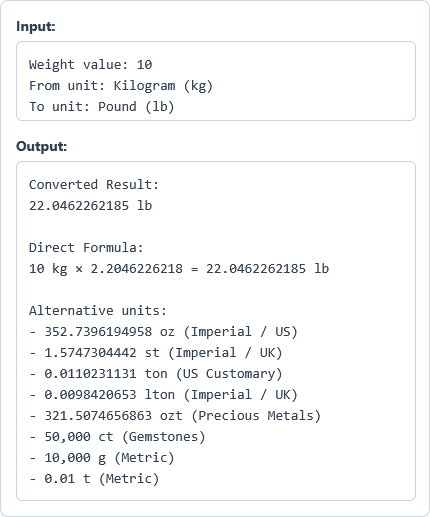
Example Input
Weight value: 10
From unit: Kilogram (kg)
To unit: Pound (lb)
Example Output
Converted Result:
22.0462262185 lb

Direct Formula:
10 kg × 2.2046226218 = 22.0462262185 lb

Alternative units:
- 352.7396194958 oz (Imperial / US)
- 1.5747304442 st (Imperial / UK)
- 0.0110231131 ton (US Customary)
- 0.0098420653 lton (Imperial / UK)
- 321.5074656863 ozt (Precious Metals)
- 50,000 ct (Gemstones)
- 10,000 g (Metric)
- 0.01 t (Metric)
A 10-kilogram mass equals 22.0462262185 pounds, displayed up to 10 decimal places for exact trade and scientific reference.
Frequently Asked Questions
What is the physical difference between mass and weight?
Mass measures the actual amount of matter in an object and stays the same everywhere, whereas weight measures the pull of gravity on that mass and changes slightly by location. In everyday use and commerce, weight units like kilograms and pounds are legally used as standard units of mass.
Why does a troy ounce weigh more than a standard ounce?
A troy ounce (approximately 31.1035 grams) is roughly 9.7% heavier than a standard avoirdupois ounce (28.3495 grams). Troy weight originates from medieval European trade in Troyes, France, and remains the global legal standard reserved exclusively for precious metals.
What is the difference between a short ton, long ton, and metric tonne?
A US short ton equals 2,000 pounds (907.185 kg), an imperial long ton equals 2,240 pounds (1,016.047 kg), and an international metric ton (tonne) equals exactly 1,000 kilograms (approximately 2,204.62 pounds). These differences come from historical trade standards in the United States and the United Kingdom.
How is the stone unit used for body weight?
One British stone equals exactly 14 avoirdupois pounds (approximately 6.3503 kg). It remains a traditional standard in the United Kingdom and Ireland, where personal body weight is commonly expressed in stones and pounds (e.g., 11 stone 4 pounds).
How does the carat unit relate to grams for gemstone weighing?
One metric carat equals exactly 200 milligrams (0.2 grams or 0.007055 oz). Formally adopted in 1907 by the Fourth General Conference on Weights and Measures (CGPM), it serves as the international standard for diamonds, gemstones, and pearls.
Are my entered weights or conversion results stored on a server?
No. All conversions happen directly in your web browser on your device. Your input values and converted results are never recorded or sent to any external server.