Temperature Converter - Celsius, Fahrenheit & Kelvin
Convert temperature values between Celsius, Fahrenheit, Kelvin, and Rankine using exact thermodynamic conversion formulas in real time.
🔒 Secure Calculation: Fast and private with zero data stored.
How to Use
- Enter your temperature reading in the input box above.
- Choose your starting scale and target scale from the dropdown selectors.
- Press the swap button (⇄) to reverse the scales, or click "Sample" to test a 100 °C boiling-point reading.
- Review your converted reading, the step-by-step formula breakdown, and the live comparison matrix across all 8 scales.
Key Features
- Two-way instant conversion across 8 modern, absolute, and historical temperature scales.
- Physical boundary check that blocks impossible readings below absolute zero (0 K).
- Standardized conversion through the SI base Kelvin (K) unit for consistent accuracy across all scales.
- Exact decimal rounding up to 10 decimal places to prevent calculation discrepancies.
- Supports weather forecasting, HVAC system design, cooking temperatures, and thermodynamic laboratory work.
- 100% private, client-side computing with zero data sent or stored on external servers.
Conversion Formula and Calculation Logic
Unlike length or weight, temperature scales do not start at the same zero point. The temperature converter first converts your reading into Kelvin (K)—the SI base unit for thermodynamic temperature—before applying the exact scale ratio and zero-point shift to reach your target unit:
1. Celsius (°C) and Kelvin (K):
   K   = °C + 273.15
   °C  = K - 273.15

2. Fahrenheit (°F) and Celsius (°C):
   °F  = (°C × 9/5) + 32
   °C  = (°F - 32) × 5/9

3. Rankine (°R) and Kelvin (K):
   °R  = K × 9/5
   K   = °R × 5/9
Converting every reading through the absolute Kelvin base scale keeps multi-scale comparisons consistent and prevents intermediate rounding errors.
Developed and maintained by the CalcPly team, this tool implements official NIST SP 811 conversion formulas and ISO 80000-5 thermodynamic temperature standards.
Example Input and Output
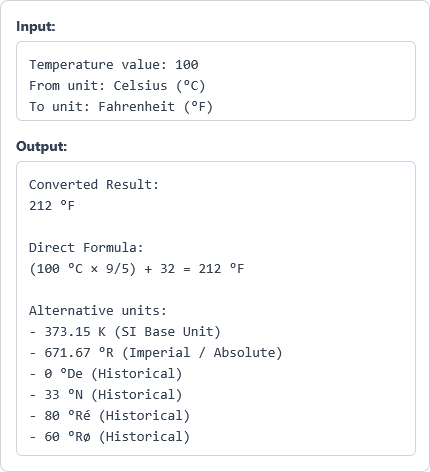
Example Input
Temperature value: 100
From unit: Celsius (°C)
To unit: Fahrenheit (°F)
Example Output
Converted Result:
212 °F

Direct Formula:
(100 °C × 9/5) + 32 = 212 °F

Alternative units:
- 373.15 K (SI Base Unit)
- 671.67 °R (Imperial / Absolute)
- 0 °De (Historical)
- 33 °N (Historical)
- 80 °Ré (Historical)
- 60 °Rø (Historical)
A boiling-point reading of 100 °C converts to exactly 212 °F, alongside instant equivalents across all six absolute and historical scales.
Frequently Asked Questions
How accurate are the temperature conversions in this tool?
Results are accurate up to 10 decimal places. Because temperature formulas combine fractional ratios with fixed zero-point shifts, every reading is calculated through the exact Kelvin base scale with clean decimal rounding to avoid rounding discrepancies.
What is absolute zero in temperature measurement?
Absolute zero is the lowest possible physical temperature, representing the theoretical point where thermal energy is completely absent. It equals exactly 0 K, -273.15 °C, -459.67 °F, and 0 °R.
At what temperature do Celsius and Fahrenheit equal each other?
Celsius and Fahrenheit are exactly equal at -40 degrees (-40 °C = -40 °F). Solving the linear relationship equation T = (T × 9/5) + 32 confirms -40 as the single mathematical intersection point between both scales.
Why do temperature conversions require addition and subtraction?
They require addition and subtraction because each scale begins at a different starting zero point. While Kelvin and Rankine start at absolute zero, Celsius and Fahrenheit set their zero marks at the freezing points of pure water and brine solution, requiring an offset adjustment alongside the degree size ratio.
What is the Rankine temperature scale used for?
The Rankine scale is primarily used by American engineers in aerospace and thermodynamics. It serves as the absolute temperature scale for the imperial system, using degree intervals equal in size to Fahrenheit degrees while anchoring its zero point at absolute zero.
Is any entered temperature data stored or sent to external servers?
No. Every calculation runs 100% inside your web browser using client-side computing. Your readings, selected scales, and generated links are never uploaded, logged, or saved on CalcPly servers.