Volume Converter - Liters, Gallons & Cubic Meters
Convert fluid capacity and cubic volume across metric, US customary, and UK imperial units directly in your browser using exact NIST conversion factors.
🔒 Secure Calculation: Fast and private with zero data stored.
How to Use
- Enter the liquid or cubic volume amount in the "Volume value" box above.
- Select your starting unit in the "From" dropdown and your target unit in the "To" dropdown.
- Click the swap button (⇄) to switch the From and To units, or press "Sample" to load a 10 L to US gallon example.
- Read your converted volume, the exact conversion formula, and the 12-unit comparison table below.
Key Features
- Simultaneous conversion across 12 metric, US customary liquid, and UK imperial volume units.
- Exact NIST SP 811 conversion factors referenced to the standard liter (L) and cubic meter (m³).
- Clear separation between the 231-cubic-inch US liquid gallon (3.785411784 L) and the UK imperial gallon (4.54609 L).
- Full 12-unit comparison table with up to 10 decimal places and scientific notation for extreme values.
- Shareable result links ideal for laboratory glassware, chemical dosing, engine displacement, and storage tank checks.
- 100% client-side calculation in your web browser with zero server data storage.
Conversion Formula and Calculation Logic
The volume converter converts any starting measurement into liters (L), where 1,000 liters equal one cubic meter (m³), before dividing by the target unit's exact conversion factor:
Volume in Liters (L) = Input Volume × Factor to Liter
Target Volume = Volume in Liters (L) / Target Unit Factor
Using the liter as a single reference base keeps exact unit ratios intact, including 128 US fluid ounces per gallon and 1,728 cubic inches per cubic foot, without multi-step rounding errors.
Developed and maintained by the CalcPly team, this tool calculates liquid capacity and cubic volume using official NIST SP 811 conversion factors and SI metric standards.
Example Input and Output
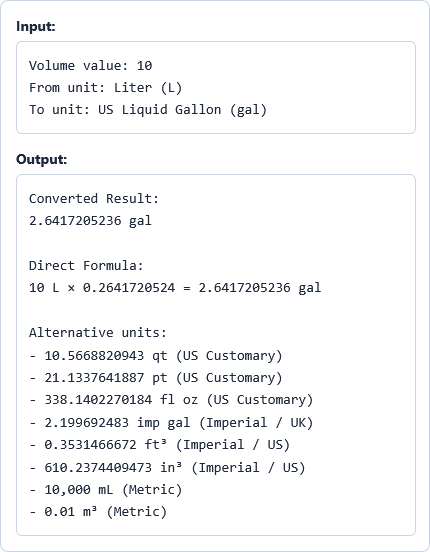
Example Input
Volume value: 10
From unit: Liter (L)
To unit: US Liquid Gallon (gal)
Example Output
Converted Result:
2.6417205236 gal

Direct Formula:
10 L × 0.2641720524 = 2.6417205236 gal

Alternative units:
- 10.5668820943 qt (US Customary)
- 21.1337641887 pt (US Customary)
- 338.1402270184 fl oz (US Customary)
- 2.199692483 imp gal (Imperial / UK)
- 0.3531466672 ft³ (Imperial / US)
- 610.2374409473 in³ (Imperial / US)
- 10,000 mL (Metric)
- 0.01 m³ (Metric)
Ten liters equal 2.6417205236 US liquid gallons (or 2.199692483 UK imperial gallons), along with exact equivalents in quarts, fluid ounces, and cubic feet.
Frequently Asked Questions
What is the difference between a US liquid gallon and a UK imperial gallon?
A UK imperial gallon equals 4.54609 liters, making it about 20.1% larger than a US liquid gallon of 3.785411784 liters. The US standard is based on the historical 1707 English wine gallon of exactly 231 cubic inches, whereas the 1824 British imperial gallon was originally defined as the volume of 10 pounds of distilled water at 62 °F.
Are milliliters and cubic centimeters equal in volume?
Yes, one milliliter (mL) is identical in volume to one cubic centimeter (cm³), and both equal 0.001 liters. Because one liter is formally defined as one cubic decimeter (10 cm × 10 cm × 10 cm = 1,000 cm³), medical syringes, laboratory glassware, and engine specifications use mL and cm³ interchangeably.
How many cubic inches are in a cubic foot, and why?
One cubic foot equals exactly 1,728 cubic inches. Because volume measures three-dimensional space across length, width, and height, a 1-foot cube has sides of 12 inches in each direction (12 in × 12 in × 12 in = 1,728 in³, just as a 1-yard cube equals 3 ft × 3 ft × 3 ft = 27 ft³).
How does a US fluid ounce compare to a UK imperial fluid ounce?
A US fluid ounce equals 1/128 of a US gallon (approximately 29.5735 mL), while a UK imperial fluid ounce equals 1/160 of an imperial gallon (approximately 28.4131 mL). Even though the imperial gallon is larger overall, dividing it into 160 parts makes an individual US fluid ounce about 4.1% larger than its UK counterpart.
Can I enter negative numbers for liquid or cubic volume?
No. Physical fluid capacity and three-dimensional space cannot fall below zero, where zero represents a completely empty container. To prevent invalid readings, the converter accepts only zero and positive numbers.
Does this tool send my volume figures or shared links to a server?
No. Every volume conversion and shareable link is calculated directly inside your web browser. Your entered quantities and unit pairs remain private on your device and are never sent to or stored on any server.